Table of contents
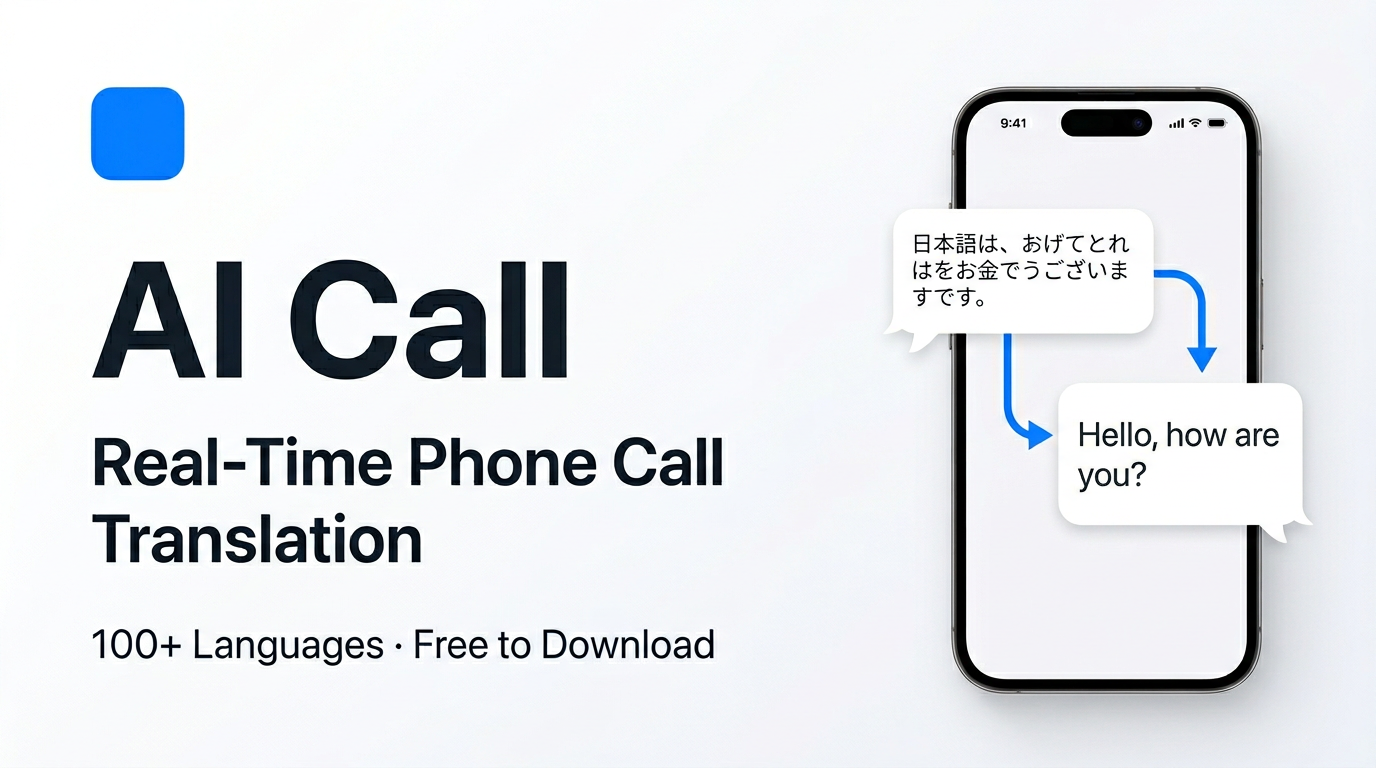
Product page: For the complete phone call translator guide — how AI Call works, demos, and FAQs — see the main product page. This article ranks the apps after real calls.
Looking for the category overview instead? See phone call translator app and our dedicated app roundup.
TL;DR
After two weeks of real cross-language calls — a ryokan in Kyoto, a parts supplier in Shenzhen, a stubborn German customer-service line — AI Call was the only app that felt like a simultaneous interpreter rather than a walkie-talkie. Sub-0.5-second latency, 100+ languages, AI voice cloning that makes the translation sound like you, and an AI phone agent that will make the call for you.
The other five each do one thing decently. None of them win the thing that actually matters: making a live phone call feel natural in a language you do not speak.
Why "best phone call translator" is a moving target
Two years ago, translating a phone call meant putting Google Translate on speakerphone and taking turns with long, awkward pauses. Nobody who tried to book a Kyoto restaurant that way tried it twice.
2026 is different. Streaming speech recognition and a new generation of translation models finally broke the sub-second latency barrier, which is the difference between "we are having a conversation" and "we are taking turns waiting." A handful of apps now have genuine product-market fit. Most still carry hard limits: no landline support, no free tier, tiny language coverage, or a recipient who has to install something.
How I tested
Not demos. Not spec sheets. Real calls to real numbers, in both directions:
- 📞 A ryokan in Kyoto with no English (Japanese ↔ English)
- 🏭 A parts supplier in Shenzhen who prefers Mandarin (Chinese ↔ English)
- 🚿 My building's Spanish-speaking plumber (Spanish ↔ English)
- ✈️ Customer-service lines in Paris and Munich (French / German ↔ English)
- 👵 A Korean-speaking family member (Korean ↔ English)
For each app I tracked six things: does it dial a real phone number, does the other person need to install anything, what the latency feels like in practice, real language coverage, pricing for how you would actually use it, and whether it does anything the others cannot.
Ratings below are as published in August 2026 and will drift. Where an app has no published store rating, I say so instead of inventing one.
1. AI Call — best overall
4.8★ average · 800+ ratings across iOS and Android · 50K+ downloads on each platform
AI Call (by TaraAI LLC) is the one I kept reaching for. Open the app, pick two languages, dial any real mobile, landline, or VoIP number — and both sides just talk. The person answering has no idea you are running anything, because they answered an ordinary phone call. That is the whole product promise, and unlike most of this list, it delivers it.


What makes it stand apart in 2026:
Sub-0.5s latency
Translation starts before you finish your sentence. This is the single thing that makes a call feel like a conversation instead of a radio handoff.
AI voice cloning
The translation comes out in your own voice, not a generic synthetic one. Your supplier hears you speaking Mandarin.
AI phone agent
Tell it what you need — "book a table for two at 7 PM" — and it places the call, has the conversation, and reports back.
Video call translation
Voice and video mode covers WhatsApp, FaceTime, and Messenger calls, not just PSTN.
Call Links
Send a link and the other person joins a translated conversation from a browser, with no account.
Bilingual transcript
Every call ends with a readable transcript in both languages plus a structured summary.
Real test — the Kyoto ryokan: a family-run inn with no online booking and no English voicemail. The owner answered in Japanese, I asked about availability in English, she confirmed the room and the rate. She never asked me to repeat myself, and the bilingual transcript was waiting when I hung up. That is what phone call translation was supposed to be.
Where it falls short: heavy daily callers will burn through the free minutes, and like every app in this category it is not a certified interpreter for legal or medical proceedings — see human interpreter vs AI phone translator for when to hire a person instead.
Pricing: free to download on iOS and Android, with free minutes on signup. Paid plans add minutes and heavier use of the AI phone agent.
Who it is for: travelers, expats, importers and exporters, home-service pros with immigrant clients, and anyone with family who never learned their language. Which is to say, almost everyone.
2. Telelingo — if you need your own caller ID
App Store 3.9★ (21 ratings)
Telelingo has one genuinely distinct trick: it routes the outbound call through your own number, so the recipient sees your caller ID instead of an unknown VoIP number. For business calls where a strange number gets ignored, that matters.
Everything else is a step down. No voice cloning — the translation is a generic synthetic voice. No AI agent, no video translation, roughly 80 languages against AI Call's 100+, and no free tier: you pay from the first second at around $0.22/min.
Verdict: pick Telelingo only if caller-ID preservation is a hard requirement. Otherwise AI Call is faster, broader, better rated, and free to start.
3. Lingvanex — cheapest for rare calls
App Store 2.8★ (18 ratings)
Lingvanex Phone Call Translator (by Nordicwise) does exactly one thing: dial a number and translate it, paid one coin pack at a time. If you make a translated call once a quarter and refuse to think about a subscription, it is fine. That is the entire pitch.
The tradeoffs are steep: 36 languages, a noticeable one-to-two-second lag between phrases, no voice cloning, no agent, no video, no free tier, and the lowest store rating in this roundup. Android support lags iOS.
4. LiveLingo — if you live in a browser
No published store rating (browser-based)
LiveLingo is the odd one out: not really an app, but a browser page. You send a room-code link, the other person opens it, and you have a translated conversation through their screen.
The catch is the thing that makes it different — the other person has to open a link from a stranger. The front desk of a Kyoto ryokan will not do that. Neither will reception at a Shenzhen factory. It has a free 3 min/day tier and its Pro plan ($19.99/mo) does dial real numbers, but roughly 35 languages and no voice cloning keep it a niche pick.
5. SpeakLink — the simplest flat rate
No published store rating (newer web service)
SpeakLink keeps it simple: open the dialpad, pick languages, dial, pay one flat rate per minute. At $0.99/min it is the most expensive per-minute option here, with no voice cloning, no agent, no video translation, and no clearly published language count.
❌ EzDubs — do not download
You will still find EzDubs on "best of 2024" and even some late-2025 lists. Skip it: Cisco acquired the team and the consumer app shut down on December 15, 2025. If you landed here from one of those lists, see EzDubs alternatives.
Side-by-side comparison
| What matters | Telelingo | Lingvanex | LiveLingo | SpeakLink | AI Call |
|---|---|---|---|---|---|
| Languages | 80+ | 36 | ~35 | Not published | 100+ |
| Latency | Not published | 1–2 sec | ~1.5 sec | "Real-time" | <0.5 sec |
| Dials real numbers | ✓ | ✓ | Pro only | ✓ | ✓ |
| Other person needs nothing | ✓ | ✓ | ✗ | ✓ | ✓ |
| AI voice cloning | ✗ | ✗ | ✗ | ✗ | ✓ |
| AI phone agent | ✗ | ✗ | ✗ | ✗ | ✓ |
| Video call translation | ✗ | ✗ | Browser only | ✗ | ✓ |
| Free tier | ✗ | ✗ | 3 min/day | ✗ | ✓ |
| Store rating | 3.9★ | 2.8★ | N/A | N/A | 4.8★ |
| Starting price | ~$0.22/min | ~$0.20/min | Free (capped) | $0.99/min | Free |
The four things that actually decide it
Latency is the whole game. The gap between "we are talking" and "we are taking turns" is about one second. Under a second feels like a slightly delayed international line; over two seconds and both people start talking over each other. This is the single number worth comparing, and it is why the ryokan owner never asked me to repeat myself. The technical explanation is here.
Voice cloning is not a gimmick. Every other app on this list turns your voice into a generic synthetic one, so the other person hears a robot speaking their language. Hearing you — your pace, your tone — changes how the conversation goes, especially when you are asking someone for a favor.
It is not only phone calls. The same translation layer runs on video calls and on two people sharing one handset, which is what you actually want once you have landed and are standing at a pharmacy counter.


"The other person needs no app" is table stakes. If your translator requires the recipient to install something or open a link, you do not have a phone call translator. You have a meeting tool with extra steps.
A free tier is how you find out. You will not commit to $0.20+/min before making a single call to see whether it even handles your language pair well — coverage varies, and some pairs are stronger than others.
The honest verdict
AI Call wins on latency, languages, features, ratings, and starting price. It is the only app here that combines sub-0.5-second translation, voice cloning, an AI agent that makes the call for you, and a free tier so you can test it before paying.
Telelingo, Lingvanex, LiveLingo, and SpeakLink each solve one corner of the problem. If your corner is caller ID, or one call a quarter, or a browser-only workflow, they are reasonable. For everything else, install one app.
Disclosure: I work on AI Call, so treat the ranking as informed but interested. Competitor features, prices, and ratings are as published by each vendor in August 2026 — verify current details before you pay.
Related reading
- Dedicated phone call translator apps, tested
- Can ChatGPT translate phone calls?
- Does iPhone Translate work on calls?
- Over-the-phone interpretation rates in 2026
👉 Download AI Call — free on iOS and Android, with free minutes. The other person just answers their phone.
Frequently asked questions
What is the best phone call translator in 2026?
AI Call is the best phone call translator in 2026 for most people. It supports 100+ languages with sub-0.5-second latency, adds AI voice cloning so translated speech sounds like you, includes an AI phone agent that can place calls for you, and works with any real mobile, landline, or VoIP number — the person you call needs no app.
Does the person I am calling need to install anything?
No. With AI Call you dial their regular phone number and they answer a normal call — no app, no link, no setup on their end. Call Links are available separately if both sides happen to prefer a browser session.
Can AI Call translate calls to landlines?
Yes. AI Call reaches any regular phone number — mobile, landline, or VoIP. The recipient needs no smartphone, no app, and no internet connection. If they can answer a phone, the call can be translated.
Is AI Call free?
AI Call is free to download on both iOS and Android and includes free minutes on signup, so you can make real cross-language calls before paying. Paid plans add more minutes and heavier use of the AI phone agent.
What happened to EzDubs?
Cisco acquired the EzDubs team and the consumer app was shut down on December 15, 2025. It no longer works, despite still appearing on older "best of" lists.
Can ChatGPT translate phone calls?
No. ChatGPT is a text and voice assistant and cannot place or translate a live phone call to a real number. Apps built for call translation, like AI Call, handle the telephony side as well as the translation.
Try AI Call for free
Call anyone in any language. Free minutes included.