Table of contents
Want an AI receptionist that answers in your caller’s language? See the multilingual AI receptionist in AI Call Business.
Quick answer
When your team can’t pick up, a call goes to one of three places:
- Voicemail: cheapest, but many callers hang up, and nothing gets answered.
- A human answering service: a person takes the call from a script and passes on a message.
- An AI receptionist: an AI voice agent answers live, answers common questions from your own information, takes a message and can hand the caller to a person.
For most small businesses the best setup is an AI receptionist for after-hours and overflow calls, with your own team answering everything else.
Side-by-side comparison
| Voicemail | Human answering service | AI receptionist | |
|---|---|---|---|
| Answers live | No | Yes, during the service’s hours | Yes, whenever you switch it on |
| Caller’s language | Recorded as spoken | Depends on the staff | Can speak the caller’s language |
| Answers questions | No | From a script | From your own documents |
| What your team gets | A recording | A message | A message, summary and transcript |
| Cost model | Usually included | Monthly plan or per call/minute | Per minute or a monthly bundle |
| Judgment and empathy | None | Human | Limited: it should hand over to a person |
When voicemail is enough
If you get only a few calls a week outside business hours and callers rarely need an answer right away, voicemail is fine. Make it better with transcribed and translated voicemail, so anyone on the team can read and act on it, even if the caller spoke another language.
When a human answering service fits
A human service makes sense when calls need empathy or judgment that can’t wait, and when the callers speak the same language as the service’s staff. Ask about its hours, languages and how messages reach you.
When an AI receptionist fits
An AI receptionist is strongest when:
- calls arrive after hours or when your small team is busy;
- many callers ask the same questions (hours, prices, delivery status, how to order);
- callers speak another language than your team;
- you want a written record of every call.
What a good AI receptionist should do
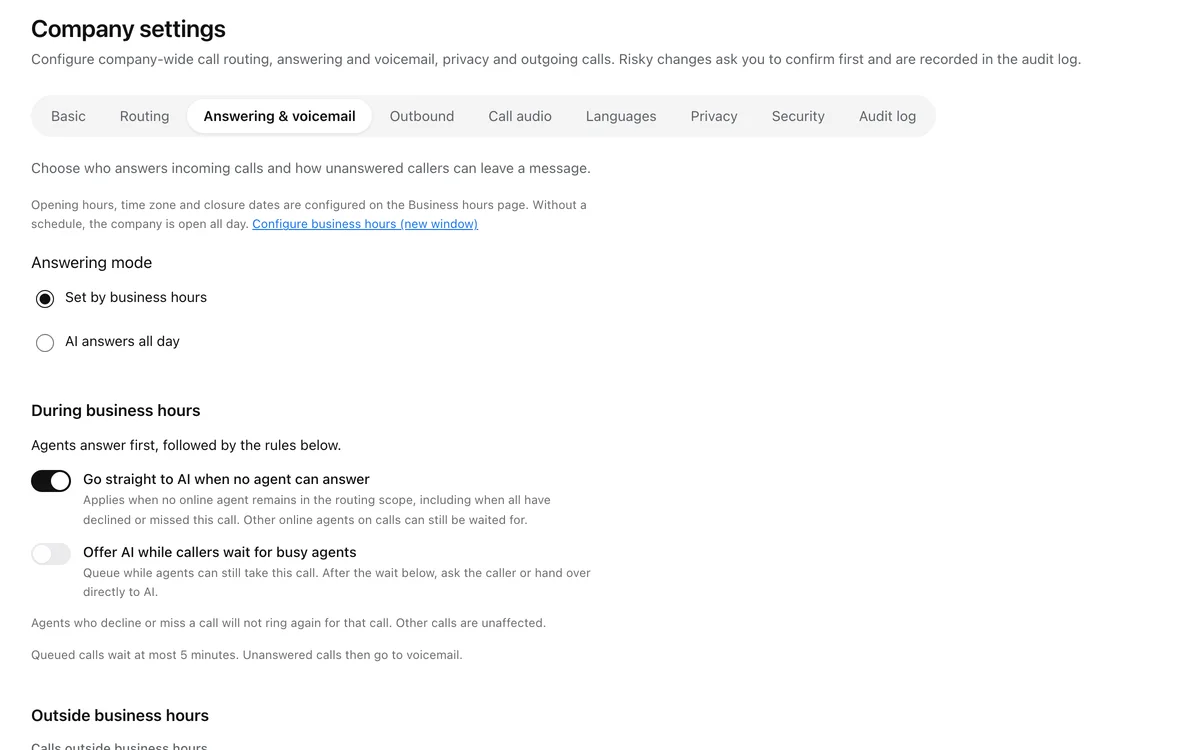
- Answer when you choose: every call, after hours, when nobody is online, or when the queue is too long.
- Answer from your information: company details, opening hours and the documents you upload. It shouldn’t make up prices or promises.
- Take a complete message: name, callback number and reason for the call.
- Hand over to a person when one is available and the caller asks.
- Say that it is an AI.
What it shouldn’t pretend to do
Be wary of an AI receptionist sold as a full replacement for staff. The one in AI Call Business is deliberately scoped: it handles incoming calls and doesn’t place outbound calls, book appointments or update other systems. Your team follows up from the message it leaves, which keeps people in charge of commitments.
What it costs
Answering services are usually priced as monthly plans or per call or minute. AI receptionists are usually priced per minute answered. For example, the AI Call Business AI receptionist is $0.15 per minute it answers, or $69 a month for 500 minutes, on top of a call center plan from $39 per seat per month (billed annually). See the full AI call center pricing.
A simple setup for a small team
- Put your opening hours, FAQs and price list into the knowledge base.
- Let your team answer during business hours.
- Switch on the AI receptionist for after hours and for callers who wait too long.
- Read the messages and summaries each morning and call people back.
Bottom line
Voicemail is cheap but answers nothing. A human answering service brings judgment but is limited by its staff’s hours and languages. An AI receptionist answers whenever you want, in the caller’s language, and leaves your team a complete written message. That makes it the practical choice for after-hours and overflow calls.
👉 Try AI Call Business free: 30 minutes of translated calls, no card.
Frequently asked questions
Is an AI receptionist better than an answering service?
It depends on the calls. An AI receptionist is available whenever you switch it on, answers from your own documents and can speak the caller’s language; a human answering service brings human judgment but works from a script and is limited by its staff’s hours and languages. Many small businesses use an AI receptionist for after-hours and overflow calls and keep people for the rest.
Can an AI receptionist book appointments?
Some can, but check before you buy. The AI receptionist in AI Call Business handles incoming calls only: it answers questions from your information, takes a complete message and can transfer to an agent, but it does not book appointments or place outbound calls.
Will callers know they are talking to an AI?
They should. A good AI receptionist says up front that it is an AI. AI Call Business also plays a short notice that the call is translated and may be recorded.
How much does an AI receptionist cost?
Usually per minute or as a monthly bundle. The AI Call Business AI receptionist is $0.15 per minute it answers, or $69 a month for 500 minutes, on top of a call center plan.
Try AI Call for free
Call anyone in any language. Your first translated call is free (up to 2 min).
