Table of contents
Spanish-speaking callers and an English-speaking team? AI Call Business translates every call live in both directions, in a call center that runs in the browser.
Quick answer
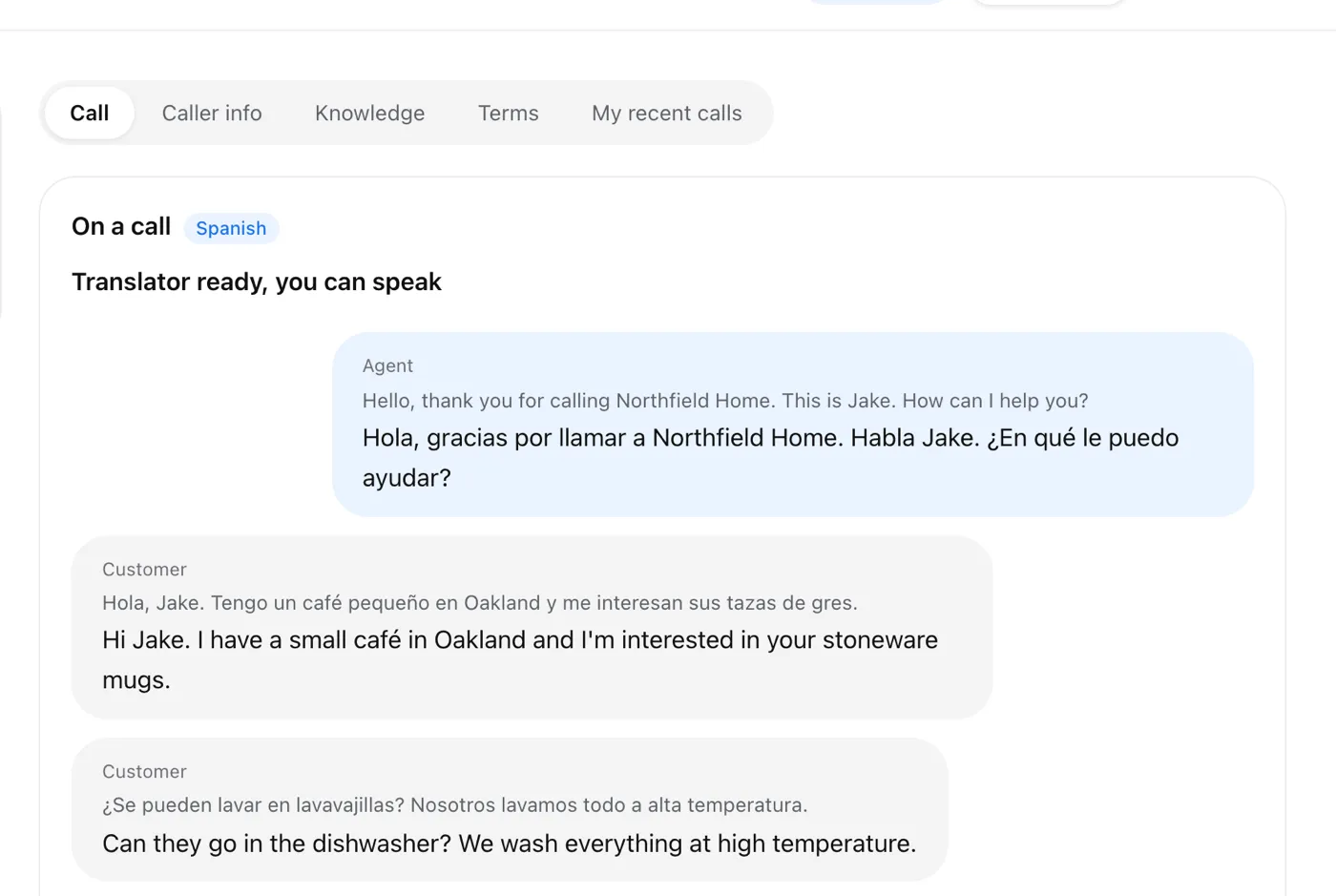
Call center Spanish translation lets your English-speaking agents talk with Spanish-speaking callers live, with no bilingual hire and no interpreter on the line. The caller dials your normal number, picks Spanish in the phone menu and speaks Spanish; the agent hears English and reads both languages as subtitles. When nobody is available, an AI receptionist answers in Spanish and takes a message for your team.
Why Spanish comes first
Spanish is by far the most common language other than English in US homes:
- About 44.9 million people age 5 and over spoke Spanish at home in 2024, roughly 1 in 7.
- 41.1% of them, about 18 million people, said they speak English less than “very well”.
Source: US Census Bureau, American Community Survey 2024.
For a business with US customers, that is the largest group of callers who would rather not do the call in English.
Four ways to handle Spanish calls
| Option | What it costs | Trade-off |
|---|---|---|
| Bilingual agents | Hiring, often a bilingual pay premium | Only those agents can take Spanish calls; hard to cover every shift |
| Phone interpreter | Typically around $1–5 per minute (rates) | A third person on the line, connect time, longer calls |
| Voicemail or callback | Little | Callers who never call back |
| Live AI call translation | Seat plus translated minutes | Any agent on any shift; glossary and read-back habits matter |
Live call translation is the only option where the team you already have can answer every Spanish call directly.
How a translated Spanish call works
- The customer dials your local or toll-free number. They need no app.
- The phone menu offers Spanish (“Para español, oprima 2”), and the call rings through to your agents.
- The caller speaks Spanish; the agent hears English.
- The agent answers in English; the caller hears Spanish.
- Both sides appear on the agent’s screen as live subtitles, original and translation.
- After the call, an AI summary and the full transcript are saved for follow-up.
A short example from a delivery question:
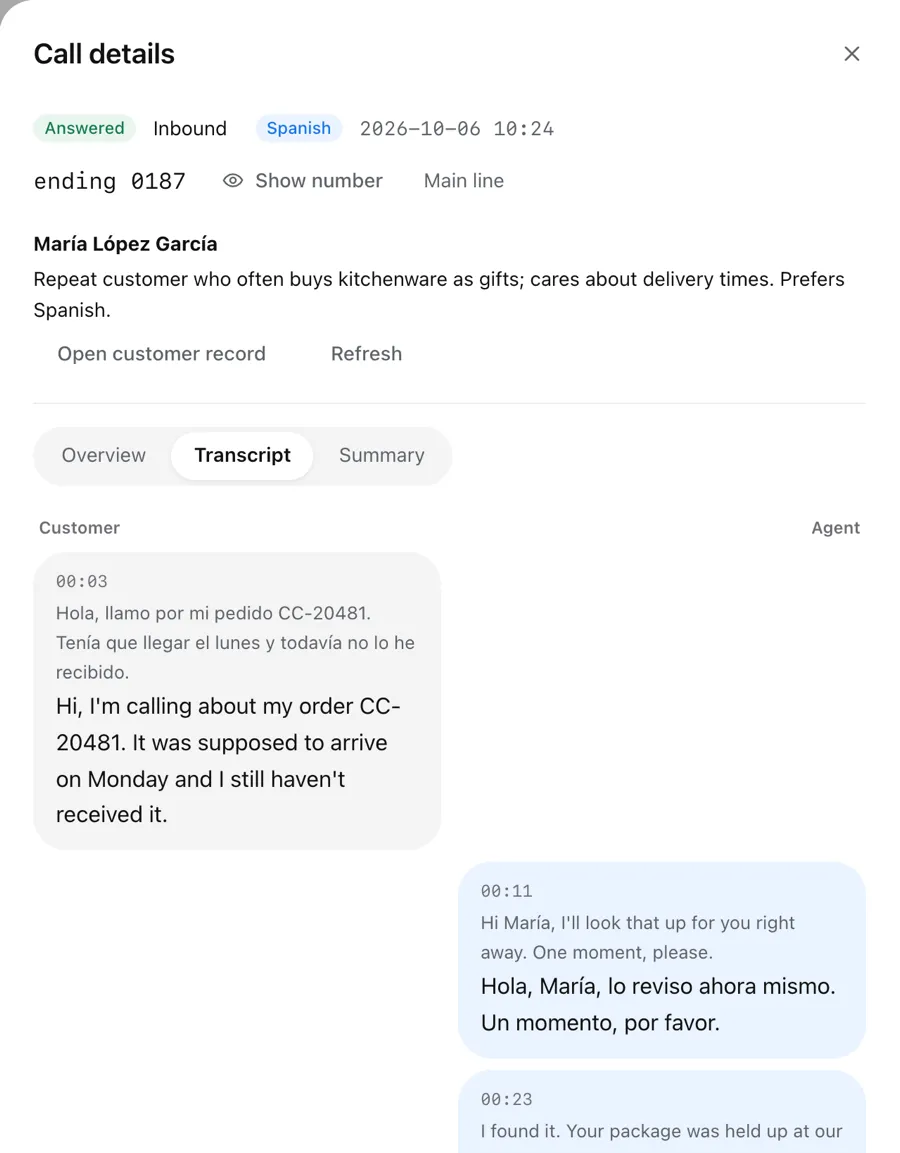
Caller (Spanish): “Hola, llamo por mi pedido. No ha llegado y el número de seguimiento termina en 4821.” Agent hears: “Hi, I’m calling about my order. It hasn’t arrived and the tracking number ends in 4821.” Agent (English): “Sorry about that. It left our warehouse on Tuesday and should arrive Friday.” Caller hears: “Lo siento. Salió de nuestro almacén el martes y debería llegar el viernes.”
Setting it up for Spanish callers
1. Add Spanish to the phone menu
Use the IVR menu so callers choose Spanish before the call rings through. Keep the Spanish option early in the menu so callers hear it in the first few seconds.
2. Let every agent take Spanish calls
With translation inside the call, Spanish calls do not need a separate “Spanish queue” staffed by bilingual agents. Route them to the same ring groups as English calls, and use the live view to see who is free.
3. Fill the glossary and the Knowledge Center
Add product names, plan names and brand terms to the company glossary so they are translated the same way on every call. Upload FAQs, policies and price lists to the Knowledge Center so agents see suggested answers during the call.
4. Teach three Spanish-specific habits
- Read numbers back. Callers often say phone numbers and order numbers in pairs (“cuarenta y ocho, veintiuno”). Agents should repeat the full number before acting on it.
- Confirm dates by month name. “03/04” means April 3 in most Spanish-speaking countries, not March 4. Say “April 3” out loud.
- Ask for both surnames. Many Spanish-speaking customers use two surnames (María López García). Search your records by both, or the account looks missing.
5. Cover after-hours calls
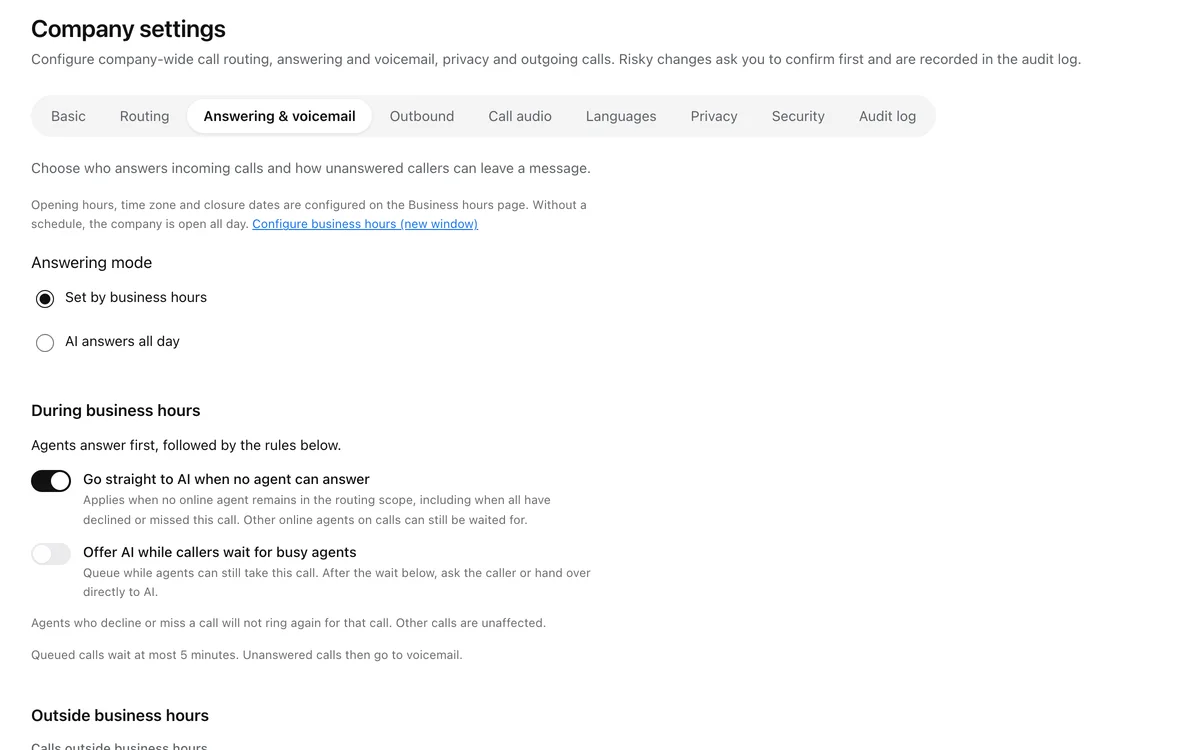
Switch on the AI receptionist for evenings, weekends and calls that wait too long. It speaks Spanish with Spanish-speaking callers, says up front that it is an AI, answers from your documents, and saves a translated message (name, callback number and reason) for the morning. It transfers to an agent only when you allow transfers and the caller asks.
6. Review a few calls each week
Read a sample of Spanish-call transcripts and summaries. Add any term that came out wrong to the glossary, and any repeated question to the Knowledge Center.
What it costs
AI Call Business pricing is seats plus the minutes you use:
- Seat: $39 per seat per month billed annually ($49 monthly), including 100 translated minutes per seat, shared by the team, and one local number.
- Translated minutes beyond that: $0.20 per minute (about $12 an hour).
- AI receptionist: $0.15 per minute it answers, or $69 a month for 500 minutes.
Example: a team of 3 agents with 1,000 minutes of Spanish calls a month pays $117 for seats (which include 300 minutes) plus $140 for the other 700 minutes: $257 a month. The same 1,000 minutes through a phone interpreter at $1–5 per minute would cost $1,000–5,000.
Teams with more than 10 seats or more than 50,000 minutes a month get a plan sized with them.
What it is not
- Not a certified interpretation service. It is a call center with live AI translation, built for customer service, sales, scheduling and follow-up calls.
- The AI receptionist answers inbound calls only. It does not place outbound calls, book appointments or write to other systems.
- Language pairs are set up per team. Spanish callers with an English-speaking team is one pair; for any other pair, email support@1aicall.com and the team confirms what is available.
Related guides
Bottom line
Spanish-speaking callers are the largest group of US customers who would rather not talk in English. With live two-way call translation, every agent on every shift can answer them in Spanish, and an AI receptionist covers the hours nobody is in.
Frequently asked questions
How can an English-speaking team handle Spanish-speaking callers?
Put live two-way call translation inside the call. The caller speaks and hears Spanish, the agent speaks and hears English, and the agent reads both languages as live subtitles. AI Call Business does this in a browser call center; the caller dials a normal phone number and needs no app.
How many people in the US speak Spanish at home?
About 44.9 million people age 5 and over spoke Spanish at home in 2024, roughly 1 in 7, according to the US Census Bureau’s American Community Survey. 41.1% of them said they speak English less than “very well”.
Does AI call translation work with different Spanish accents?
AI Call Business supports Spanish as a customer language, including regional variants such as Mexican, US and Spain Spanish. Add your product names to the company glossary, and have agents read back numbers, dates and addresses, as they would on any call.
Can an AI receptionist answer Spanish calls after hours?
Yes. The AI receptionist answers inbound calls in the caller’s language, says it is an AI, answers from your company details and documents, and takes a message (name, callback number and reason) translated for your team. It does not book appointments or place outbound calls.
What does Spanish call translation cost compared with a phone interpreter?
Phone interpreters typically cost around $1–5 per minute. AI Call Business costs $39 per seat per month billed annually, with 100 translated minutes per seat included, then $0.20 per translated minute.
Is AI call translation a certified interpretation service?
No. AI Call Business is a call center with live AI translation, not a certified interpretation service. It is built for customer service, sales, scheduling and follow-up calls.
Try AI Call for free
Call anyone in any language. Your first translated call is free (up to 2 min).
